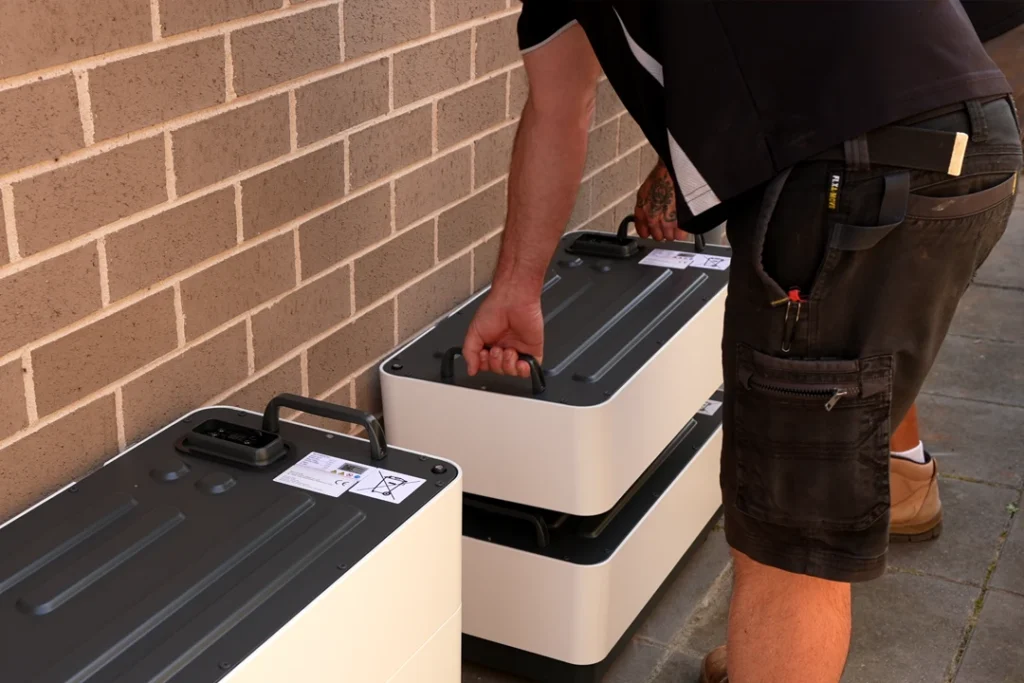
Here is what you are leaving on the table
If you have solar panels on your roof but no battery, you are in good company. Hundreds of thousands of Victorian homes installed solar in the years before batteries became affordable or well-supported by government incentives. But in 2026, the numbers have shifted considerably. What felt like a complete solar setup a few years ago is now, for many households, only working at half its potential. Here is why, and what you can do about it.
Looking to install a solar battery?
Let’s have a chat. Our local team’s here to walk you through it, step by step.
The problem with solar and no battery in 2026
When you installed your solar system, the deal probably felt pretty good. You generate your own power during the day, reduce your grid consumption and get paid a feed-in tariff for whatever you export. For a while, that worked well enough.
But feed-in tariffs across Victoria have dropped sharply over the past few years. Many households are now earning as little as 3 to 5 cents per kilowatt hour for the solar power they send to the grid. At the same time, the rate they pay for electricity at night, when solar is not generating, sits at 35 to 50 cents per kilowatt hour depending on their tariff.
That means every kilowatt hour you export during the day is being sold for about 4 cents and bought back at night for up to 50 cents. That is a twelve-to-one difference. A battery does not solve every energy problem, but it does address that specific issue very effectively, and in 2026 with the federal rebate available, it has never been more affordable to fix it.
3 to 5c
Typical Victorian feed-in tariff per kWh exported
35 to 50c
Typical peak grid electricity cost per kWh
Up to 12x
Difference between export and import rate
~30%
Upfront discount via federal battery rebate
Where your solar energy goes without a battery
WITHOUT A BATTERY
Your solar energy on a typical weekday
Solar generates from around 8am. You are at work. The house uses a small amount for standby loads. The rest, often 70 to 80 per cent of total generation, is exported to the grid for 3 to 5 cents per kilowatt hour.
You come home at 6pm. The solar has stopped generating. You use the grid for cooking, appliances, heating and the TV. You pay 35 to 50 cents per kilowatt hour for every unit you use.
WITH A BATTERY
Your solar energy on a typical weekday
Solar generates from around 8am. Excess generation fills the battery instead of going to the grid. By mid-afternoon your battery is charged.
You come home at 6pm. The battery powers your evening. You draw little to nothing from the grid. The electricity you use cost you the price of your solar system, not 35 to 50 cents a unit.
Can a battery be added to my existing solar system?
For most South-East Melbourne homeowners, yes. A battery can be retrofitted to an existing solar and inverter setup in the majority of cases. The key variable is your current inverter. Some older string inverters require an additional battery inverter or hybrid inverter to be installed alongside the battery, while newer or hybrid-ready inverters can accept a battery more directly.
Electrical Masters assesses your existing system before recommending any battery product. We look at your inverter brand and model, your switchboard capacity, your roof and meter setup, and your energy consumption data. In some cases a switchboard upgrade is required before a battery can be safely connected. We will tell you upfront if that applies to your home and what it involves.
Good news for existing solar owners
The federal Cheaper Home Batteries Program applies to batteries retrofitted to existing solar systems, not just new combined installs. As long as your solar system is grid-connected and the battery meets the program’s technical requirements, you are eligible for the rebate regardless of when your solar panels were installed.
How the retrofit process works with Electrical Masters
Adding a battery to your existing system is a straightforward process when handled by an experienced installer. Here is what to expect when you work with Electrical Masters:
We start with a free site assessment where we review your existing solar system, inverter, switchboard and energy data. We then recommend the most suitable battery brand and capacity for your setup and provide a written quote showing the full price, the federal rebate as a separate line item, and the post-rebate price you will pay.
Once you give us the go-ahead, our in-house team carries out the installation, typically in a single day for a standard residential retrofit. We handle all grid connection paperwork and ensure your system is configured for maximum self-consumption from day one. We then walk you through your monitoring app so you can see your solar, battery and grid usage in real time.
What size battery do I need?
Battery sizing depends on your household’s daily energy consumption and how much of your solar generation is currently being exported. As a general guide, most South-East Melbourne family homes are well served by a battery in the 10 to 13 kilowatt hour range. This is typically enough to cover evening and overnight usage and captures a meaningful portion of daytime solar generation that would otherwise be exported.
A battery that is too small will fill up quickly and still leave you exporting mid-afternoon generation. A battery that is too large will never fully charge on a typical day and will have a longer payback period. Getting the sizing right matters, and it starts with looking at your actual energy data rather than guessing.
Electrical Masters reviews your electricity bills and solar monitoring data as part of every battery assessment. We will recommend a system size based on what your household actually uses, not what sounds impressive on a spec sheet.
Planning to get an EV or heat pump?
If you are thinking about an electric vehicle or a heat pump hot water system in the next year or two, factor that into your battery sizing now. Both add meaningful electricity load to your household, and a battery sized for today’s usage may not be the right fit for tomorrow’s. Electrical Masters can size your system to account for planned electrification upgrades so you do not need to upsize the battery later.
Frequently asked questions
Will any battery work with my existing solar inverter?
Not necessarily. Battery compatibility depends on your existing inverter brand, model and age. Some older inverters require an additional hybrid inverter to interface with a battery, while others are battery-ready. Electrical Masters assesses your current setup before recommending any product, and we will tell you honestly if a component upgrade is needed alongside the battery.
Do I qualify for the federal battery rebate even though my solar was installed years ago?
Yes. The Cheaper Home Batteries Program rebate applies to battery installations on existing grid-connected solar systems regardless of when the solar was installed. The eligibility criteria relate to the battery and the installation, not the age of your solar panels.
How long does a battery retrofit take?
Most standard residential battery retrofits in South-East Melbourne are completed in a single day. If a switchboard upgrade or additional inverter work is required, it may take two days. We give you a clear timeline before we start.
Will adding a battery void my solar panel or inverter warranty?
In most cases, no. Adding a battery does not affect the warranty on your existing solar panels. Inverter warranties can be affected if the battery installation modifies the inverter configuration, which is why it is important to use a qualified, accredited installer. Electrical Masters ensures all work is carried out in a way that preserves your existing product warranties wherever possible.
How do I know if a battery will genuinely save me money?
The best way is to have your actual energy data reviewed rather than relying on generic estimates. Electrical Masters reviews your electricity bills and solar monitoring history as part of every free assessment. We will give you a realistic projection of annual savings and payback period based on your specific household, not an industry average.