The Ultimate 2026 Guide to 8kW Solar Systems: Costs, Batteries, and ROI
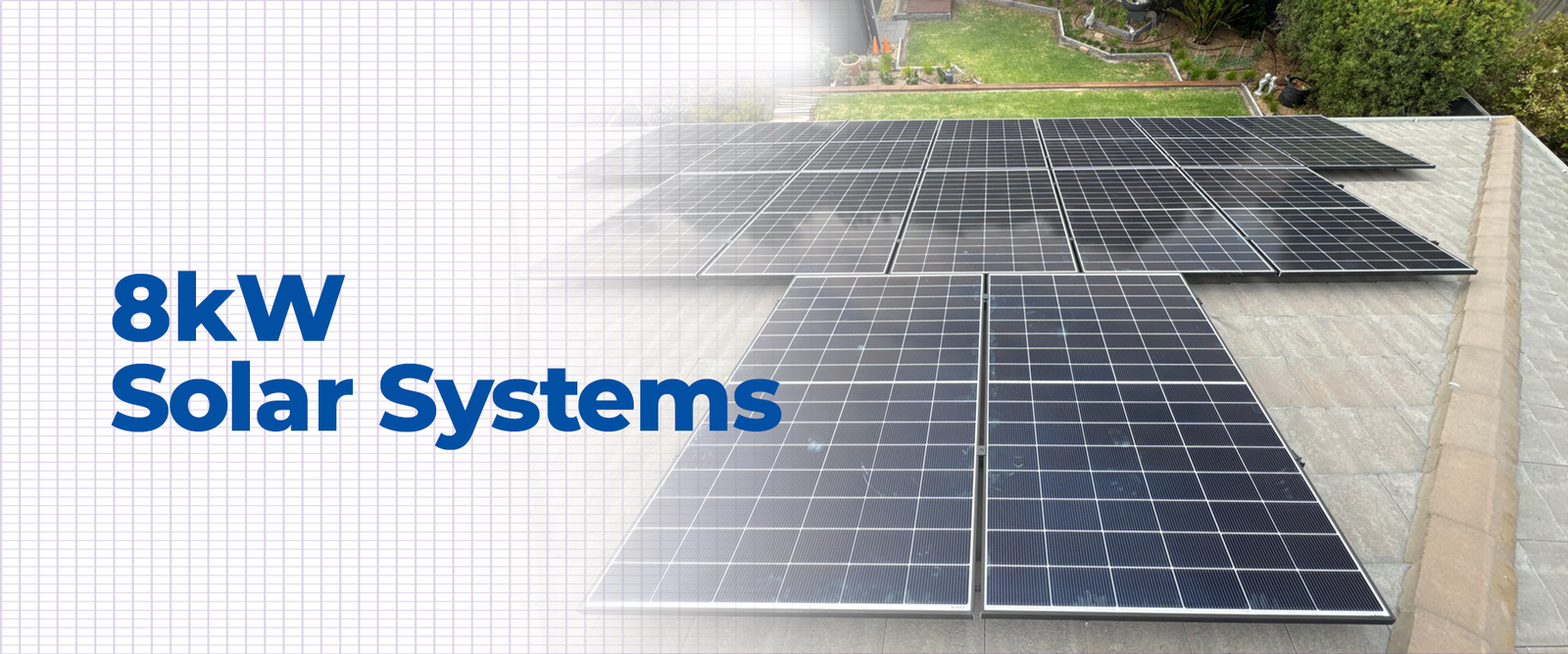
The 8kW solar system has officially passed the 6.6kW model as the most popular option for Australian urban houses. With the rise in EV ownership and the shift to all-electric homes, an 8kW system offers the “generation capacity” required to service high daily demands while still leaving enough electricity to charge a battery for late-night usage.
Get a Free Quote
How Much Does an 8kW Solar System Cost in 2026?
The price of an 8kw solar system in Australia has stabilized in 2026 as a result of better panel efficiency, while labor and compliance expenses have increased. A high-quality 8kw solar system typically costs between $7,500 and $11,500 once the government STC (Small-scale Technology Certificate) rebate is applied.
Breaking Down the First-Year ROI
An 8kW system generally produces 28 to 36 kWh of power per day for a family in Victoria. At current energy costs in 2026, this relates to an annual savings of $1,800 to $3,200, depending on your self-consumption rate. If you optimize your daytime usage—running the laundry, dishwasher, and air conditioner when the sun is out—the system will essentially pay for itself in under 4.5 years.
Going Off-Grid: 8kW Solar System with Battery Price
In 2026, around 40% of 8kW installations will have storage. The 8kw solar system with batteries costs between $17,000 and $25,000. While this is a major step up from a solar-only system, new government rebate via the “Cheaper Home Batteries Program” have made the switch more affordable.
Understanding the 8kw solar system with batteries cost
When estimating the cost of an 8kw solar system with batteries, you are paying for more than just the components. You are paying for “blackout protection” and the chance to avoid “peak-hour” power tariffs, which in many areas of Australia currently exceed 45 cents per kilowatt hour. A basic 10kWh battery combined with an 8kW array enables the average household to attain 80-90% energy independence.
8kW vs 10kW Solar System: Which is Better for You?
Many consumers are deciding between an 8kW and a 10kW solar system. The difference usually depends by your roof space and future intentions for an EV.
What is a 10 kW solar system?
A 10kW system generally has 22 to 26 panels. It’s the best option if you have a big family, a heated pool, or a high-capacity EV charger.
Comparing the 10kW Solar System Cost
While a 10kw solar system costs more (on average $9,500 – $13,500), the cost-per-watt is frequently lower than that of an 8kW system. If you have enough roof space, “oversizing” to 10kW is nearly always a better long-term financial decision.
Top 5 Components for an 8kW System in 2026
To maximize your investment, consider Tier-1 gear that can resist the severe Australian sun.
- Panels: (Jinko, Trina, REC): Look for N-Type monocrystalline panels that are at least 21.5% efficient.
- Inverters: (Fronius, Sungrow, and Enphase): A 6kW or 8kW hybrid inverter comes standard. Fronius is the more expensive option, while Sungrow provides the greatest value.
- Batteries: (Tesla Powerwall 3 / BYD): The Tesla Powerwall 3 is well-integrated, while BYD provides outstanding flexibility for those on a tight budget.
- Mounting Racking: Make sure your installer uses anodized aluminum racking approved for Australian wind conditions (AS/NZS 1170.2).
- Smart Monitoring: Systems such as Solar Analytics let you to monitor your production and usage in real time using a smartphone app.
Maximizing Your Victorian Solar Rebates
If you live in Victoria, your 8 kW system qualifies for the Solar Victoria program.
- Panel Rebate: Up to $1,400 off the initial cost.
- Interest-Free Loan: An extra $1,400 loan repayable over four years.
- Battery Rebate: While battery rebates differ by postcode, combining the state loan with the federal “Cheaper Home Batteries” rebate may reduce the overall cost of an 8kw solar system with batteries by more than $4,000.
What You Need to Know Before You Sign the quote
Buying solar in 2026 requires more than just looking at the 8kw solar system cost. Here’s your checklist:
- SAA Installer: Ensure your installer is certified by SAA (Solar Accreditation Australia).
- Phase of electricity: If you have 3-phase electricity, you may install a bigger inverter, making an 8kW or 10kW system even more efficient.
- Roof Orientation: North-facing is best for greatest production, while East/West splits are preferable for families who consume a lot of electricity in the morning and evening.
- Warranty: Demand a minimum of 25 years for panel performance and 10 years for the inverter.
- The quotation: Make sure the quotation clearly displays the “out-of-pocket” cost after any rebates have been removed.
Is 8kW the Right Choice?
For most modern Australian houses, an 8kW solar system is the most balanced financial option. It delivers enough power to drastically decrease your dependency on the grid, is perfect for the installation of a home battery, and gives a quick return on investment.
Frequently Asked Questions (FAQ)
Q. How many solar panels in an 8 kW system?
A. In 2026, with panel efficiency hitting new highs, a basic 8kW system will normally need 18 to 20 panels. If you use high-wattage 440W-450W N-Type panels, you may attain the entire 8kW capacity with just 18 panels, making it a perfect solution for houses with limited roof space.
Q. How much roof space is required for an 8 kW solar system?
A. You’ll need between 40 and 55 square meters of clean, shade-free roof area. The exact figure varies depending on the wattage of the panels you choose; higher-efficiency panels need less physical area to create the same 8kW output.
Q. Do I need a battery for my 8 kW solar system?
A. While not required, a battery is strongly advised if you consume the majority of your power at night. Without a battery, any extra solar energy is given back to the grid at a low feed-in tariff. With a battery, you can save that energy and avoid paying expensive “peak” nighttime rates, considerably increasing your total savings.
Q. How much money would I save on my electricity bill with an 8kW system?
A. While it varies by state, the typical Australian family may expect to save $450 to $800 every quarter. If you have heavy daytime consumption or a 10kWh battery installed, your yearly savings could potentially reach $3,000.
Talk to Our Expert