30kWh Solar Battery Storage
With power peak prices in Victoria routinely reaching 50c/kWh, the case for huge storage has never been stronger. A 30kWh battery is more than simply a backup, it’s a personal power station that protects your house from the fluctuations of the Australian energy market.
30 kWh battery and who needs it?
A 30 kWh battery (often called as a 30kWh solar battery) is an energy storage device that can store 30 kilowatt-hours of power. A typical Victorian family focusing consumes around 15-20 kWh each day. A 30 kwh home battery has the capacity to power your house for two days of overcast weather or many nights of heavy heating and cooling.
Is 30kWh Right for Your Home?
Most people start with a 10kWh battery, however the 30kWh battery is specially built for:
- EV Enthusiasts: Charging a large-capacity EV overnight without using grid electricity.
- All-Electric Homes: Households that have switched from gas to induction cooking and heat pumps.
- Small Businesses: Offices or workshops that must balance strong daytime demand and continue operations during blackouts.
Get a Free Quote
30kWh Battery Price: What’s the Real Cost in Victoria?
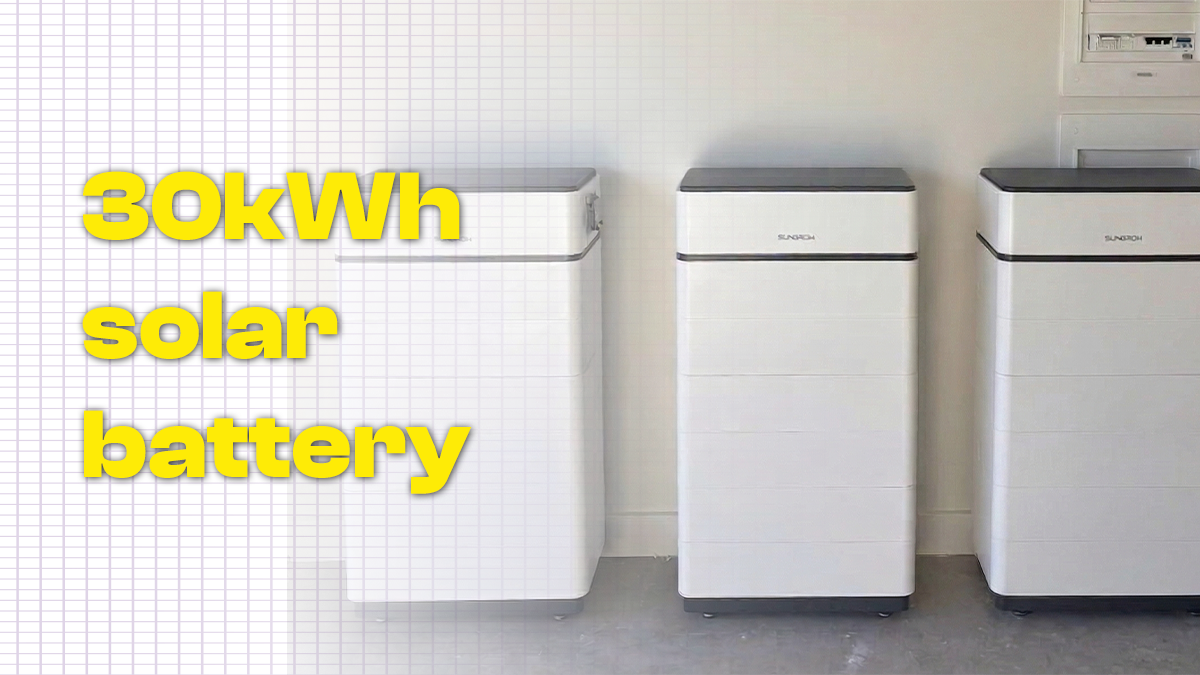
A 30kWh battery configuration is often created using modular “stacks”—such as three 10kWh units or several 5kWh modules from companies such as Sungrow or Sigenergy, rather than a single large unit. A full installation in Victoria typically costs between $20,000 and $26,000, with an extra $2,500 to $4,000 for a high-quality hybrid inverter and smart metre. When professional installation and fire-safe housing are included (averaging $2,000 to $3,500), the total expenditure before rebates ranges from $24,500 to $33,500.
When you choose an expert Victorian team like Electrical Masters, this pricing generally includes extensive house backup wiring, guaranteeing that your 30kW battery automatically powers every light and appliance when the grid fails.
The May 2026 Rebate Cliff: Why Timing is Everything
The most important detail for any 2026 buyer is the May 1, 2026 deadline. The federal “Cheaper Home Batteries” programme is going through a huge transition that mostly affects bigger systems.
Before 1 May 2026.
Currently, the refund is computed using a high STC factor (8.4), giving around $311 per kWh over the total capacity. This results in a significant $9,330 reduction provided at the moment of sale for a 30kWh system.
After May 1, 2026 (The Tapering Rule)
From May, the government will implement “Size Tapering” to prevent excessive systems:
- 0-14kWh: Gets 100% of the (reduced) rebate factor.
- 14-28kWh: Support for this segment falls to 60%.
- Above 28kWh: support for this segment declines to only 15%.
Waiting until June 2026 to install a 30 kwh battery may result in a loss of almost $3,600 in government funding compared to an April installation. This marks March and April as the “Golden Window” for high-capacity storage in Victoria.
Choosing the Right 30kWh Solar Battery Brand
In the 2026 Victorian market, Electrical Masters recommends focusing on modularity and high discharge rates to guarantee your system can deal with “spikes” from heavy-usage families.
- Sungrow SBR Series: A 30kWh stack is a high-voltage system capable of fast discharging electricity, making it ideal for starting big air conditioners.
- Sigenergy (SigenStor): The “all-in-one” option. It arranges batteries, an inverter, and an EV charger in a single column.
- BYD Battery Box: The best option for durability and cobalt-free safety. Its modular stacks enable you to start small and scale up to 30kWh as required.
Is a 30kWh Battery Worth It? Analyzing ROI
With Victorian feed-in tariffs at an all-time low (usually 5c) and grid rates at an all-time high, your 30kw solar battery pays for itself by storing energy “behind the metre.”
- Daily Savings: By using 30 units of your own solar power rather than purchasing it, you save around $15.00 every day.
- Annual Return: This amounts to almost $5,400 in bill reductions.
- Payback Period: With pre-May discounts, a 30 kwh battery may be recouped in as short as 6 to 8 years, while the technology is designed to last 15 years or more.
Why Installation Quality Matters
A 30kw battery is a huge electrical asset. This is why hiring an installation such as Electrical Masters is critical. As a Victorian-based installation, they prioritise the “behind-the-scenes” details, such as fire-rated mounting, proper air circulation, and exact smart-metering, that retailer-only companies sometimes leave behind.
When you arrive at a site looking for for a 30kwh solar battery, you’re looking for a 20-year energy companion. Electrical Masters keeps your system optimised when grid regulations and grants change.
Secure Your 30kWh Battery
Investing in a 30kWh battery is the best way for any Victorian homeowner to future-proof their house against growing energy expenses. In the current 2026 market, the financial landscape is defined by the upcoming May 1st “rebate cliff,” which represents a significant shift in government support. Currently, a high-capacity system could receive a government refund of about $9,330, reducing the usual installed price of $22,000 to $32,000 to a much more reasonable out-of-pocket cost of $12,670 to $22,670.
However, after the new tapering regulations are implemented after May 2026, government funding is expected to fall to about $5,715. This indicates that delaying a few months might result in a net cost increase of more than $3,600 for the identical equipment. Locking in your 30kw battery pricing now with a SAA-certified installation like Electrical Masters ensures that your house has a huge 30kWh daily energy capacity while the full financial benefits are still available. Taking action now assures your energy independence and ensures the quickest return on investment.
Frequently Asked Questions (FAQ)
Q. Is a 30 kWh battery too large for a typical Victorian home?
A. For a modest family, 30kWh may be more than enough. However, for contemporary Victorian houses that have gone “all-electric” (induction cooking, heat pumps, and EV charging), a 30kWh battery is the perfect size. It delivers enough “energy” to power a 5kW ducted air conditioner for 6 hours straight or charge a regular EV for around 150 km of travel, all while keeping your critical lights and refrigerator operational.
Q. How many solar panels are required to charge a 30 kWh solar battery?
A. To completely charge a 30kwh solar battery in a single day, even during a dark Melbourne winter, a solar array of 10kW to 15kW is often required. On a clear day, a 10kW system (about 22-24 panels) can create around 30-40kWh, enough electricity to power the home and fully charge the batteries.
Q. Does the 30-kWh battery pricing include blackout protection?
A. At Electrical Masters, we think that a battery of this capacity should not only save you money, but also keep you safe. Our 30-kw battery rates often include “Full Home Backup.” This means that in the event of a grid outage, the battery will immediately take over the whole switchboard, enabling you to operate high-draw appliances such as your oven or kettle, which smaller batteries are frequently incapable of handling.
Q. Can I increase the capacity of my 30kWh battery later?
A. Yes, provided you use a modular system such as the Sungrow SBR or Sigenergy. These solutions let you to “stack” additional 5kWh or 10kWh modules as your energy requirements increase. However, keep in mind that the 30kwh solar battery is currently at the top of the home rebate scale, and adding further capacity beyond the May 2026 rebate cliff would result in much less government assistance.
Q. What is the real-world lifelong of a 30 kWh household battery?
A. Most premium 30-kwh household batteries installed in 2026 use Lithium Iron Phosphate (LFP) chemistry, which is rated for 6,000 to 10,000 cycles. For the typical Victorian house, this translates to 15 to 20 years of daily usage. We provide a 10-year manufacturer warranty as standard, but the system is designed to supply dependable power long after the payback time has ended.
Talk to Our Expert