The Ultimate Guide to Commercial Solar Modules & PV Panels 2026
Commercial solar modules are heavy-duty, high-efficiency photovoltaic devices designed for large-scale corporate energy production. These commercial solar PV panels use modern N-Type, Monocrystalline, or Bifacial technology to provide huge power outputs ranging from 415W to more than 600W. With 25- to 30-year lifespans, they allow Australian businesses to greatly lower daytime running expenses, achieve quick ROI, and significantly reduce corporate carbon emissions.
Energy independence is no longer a luxury for modern Australian companies, from large industrial facilities to small retail stores. it is an essential strategy for safeguarding the bottom line from fluctuating grid rates. However, converting an important operation to renewable energy requires specialised expertise. When reviewing quotations from popular commercial solar companies, site managers must understand the specific equipment being proposed to them.
Unlike ordinary residential installations, investing in heavy-duty commercial solar panels guarantees that your system is physically and electrically strong enough to stand up to harsh conditions and continuous energy needs throughout decades of operation. This blog explains the anatomy of a solar module, the most recent high-efficiency technology, and the unquestionable financial benefits of updating your company infrastructure.
Get a Trusted Commercial Solar Company
What is a Commercial Solar Module?
A solar module (or panel) is an environmentally sealed item that captures sunlight and converts it into useable direct current (DC) power via the “photovoltaic effect.”
The architecture of a commercial-grade module is quite complex. It is made up of a grid of very sensitive silicon cells coupled by conductive metal busbars. These fragile components are sandwiched between a strong, anti-reflective tempered glass face and a protective polymer backsheet. The whole “sandwich” is then bound together by a solid, anodized aluminium frame.
The DC power supplied by these modules is subsequently sent over heavy-duty commercial cable to an inverter, which converts it into the alternating current (AC) energy needed to operate your heavy equipment, HVAC systems, and office lights.
Core Technologies in Commercial Solar PV Panels
The solar manufacturing sector has achieved huge technical advances in recent years. Today’s commercial arrays prioritise highest yield per square metre by using more sophisticated cell architectures.
N-Type and TOPCon Cell Technology
These represent the cutting-edge of modern solar performance. N-Type (Negative-Type) cells are phosphorus-treated, making them highly resistant to Light-Induced Degradation (LID), a frequent problem in which panels lose a percentage of their effectiveness after the initial exposure to sunlight. N-Type and TOPCon modules provide excellent long-term stability in intense Australian heat, with exceptionally low yearly degradation rates.
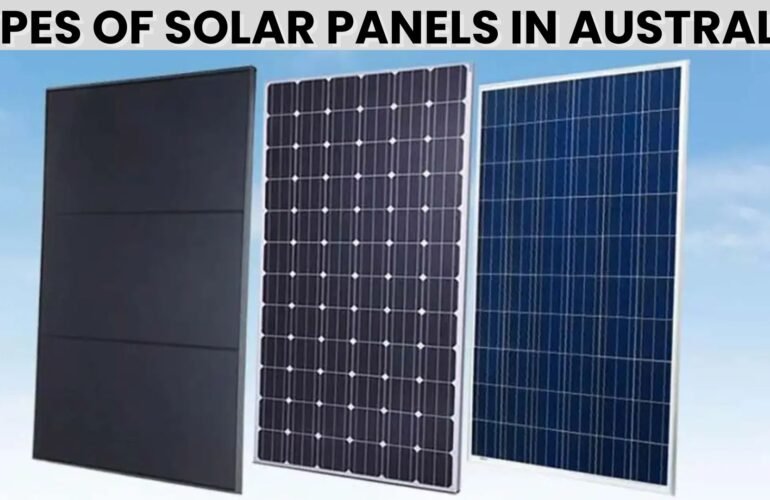
Monocrystalline (Mono-PERC)
This is still the dominating industry standard for premium installations. Mono PERC modules, made of single-crystal silicon, have very high peak efficiencies (usually between 19% and 22%). They operate well in low-light circumstances and are the best option for companies with limited roof area that demand maximum power density.
Bifacial modules
Bifacial technology has changed commercial solar architecture. These advanced panels include glass on both the front and back, enabling them to produce electricity from both direct sunlight and light from outside reflected off the roof surface below (known as albedo).
Bifacial modules are very effective when put on tilt-frames atop reflecting flat business roofs, ground-mounted solar farms, or corporate parking garages, significantly increasing total energy generation.
Commercial vs. Residential Hardware Specs
While the fundamental principles are the same, commercial gear is manufactured to a far different quality to withstand the high lifting needed by industrial facilities.
- Size and Wattage: Commercial solar PV panels are substantially bigger than household modules, frequently exceeding 2.2 metres in height, to maximise generating across huge roofs. Because of the increased surface area and high density of cells, they generally produce between 415W and 600W+ per panel.
- Structural Durability: Industrial roofs are hard settings with high wind loads, industrial emissions, and intense UV radiation. Commercial modules are built with stronger glass and strengthened aluminium frames to maintain structural integrity over their 25- to 30-year design life.
- System Scalability: Commercial solutions are very scalable. A small business may need a 30kW system, but large-scale manufacturers and cold storage warehouses often install systems ranging from 100kW to multi-megawatt (MW) arrays.
The Financial Case for Australian Businesses
The initial capital investment for a large-scale commercial array is important, but the long-term financial benefits make it one of the most secure investments a company can make. Because commercial enterprises utilise the bulk of their power during peak daylight hours, the produced solar energy is used on-site right away, eliminating costly grid electricity prices.
In many cases throughout Australia, these durable systems reach complete payback in 3 to 5 years. Following the payback period, the system effectively offers free power for the remaining decades of its life.
Furthermore, the Australian government strongly encourages company decarbonisation. Commercial systems under 100kW qualify for an upfront point-of-sale discount via Small-scale Technology Certificates (STCs). Businesses with bigger enterprise systems above 100kW may earn Large-scale Generation Certificates (LGCs), which can then be exchanged on the open market to provide a ongoing revenue stream.
By cooperating with qualified commercial solar installers and using Tier-1 commercial solar modules, your company may save operational costs, safeguard against future energy market instability, and dramatically improve its corporate sustainability credentials.